Table of Contents
From Force to Field: Field-Theoretic Description of Interactions
School physics uses force to describe changes in motion. This works well for many macroscopic problems, but it does not by itself explain how separated bodies transfer energy and momentum without instantaneous action at a distance. Modern theories treat matter and fields as one dynamical system: matter exchanges energy and momentum with local fields, and disturbances in those fields propagate at finite speed. General relativity then couples the combined stress-energy of matter and fields to spacetime geometry.
1. From force to field
An electric field is more than an intermediate device for calculating forces. It has its own state and equations of motion, and it carries energy and momentum. Radiation already emitted by a source continues to propagate after the source stops, so a complete dynamical account must include the field as well as the particles.
Consider a closed system large enough that momentum flux through its boundary can be neglected. Momentum gained by matter is then balanced by momentum lost by the field:
For a subsystem one may still write , but the force now measures its rate of momentum exchange with the rest of the system. If the chosen region is open, momentum carried through the boundary must also be included. Radiation from an accelerating charge is a standard example: the electromagnetic field carries energy and momentum away from the source. Force remains useful macroscopic language, while the field description identifies what carries the exchanged momentum.
2. Locality and causality
Once fields carry momentum, their propagation must be specified. An instantaneous change of force at a distance would conflict with relativistic causality, which limits the speed of information-bearing influence.
Local field equations relate the state at one point to the state in its immediate neighborhood. Maxwell’s equations propagate electromagnetic disturbances at . General relativity describes gravity through the metric , whose disturbances can propagate as gravitational waves. LIGO’s first direct detection in 2015 established such waves observationally, and the 2017 neutron-star merger showed that their propagation speed is extremely close to the speed of light.
In a relativistic local theory, separated bodies therefore couple to local fields rather than acting on one another instantaneously. Fields, or equivalent local degrees of freedom, connect interaction with causal propagation.
3. Symmetry and conservation laws
Local propagation calls for local conservation laws: a change of energy or momentum inside a region must be accounted for by exchange within the region or by flux through its boundary. Noether’s theorem relates this structure to continuous symmetries. Time-translation symmetry of the action gives energy conservation, while space-translation symmetry gives momentum conservation. In flat-spacetime field theory these quantities can be described by local densities and currents as well as by totals for an isolated system.
Relativity combines energy and three-momentum into four-momentum . Its components differ between inertial frames, but the four-vector transforms covariantly, so conservation in collisions and decays is frame-independent. For continuous matter and fields, the corresponding local description is the stress-energy tensor.
4. The stress-energy tensor
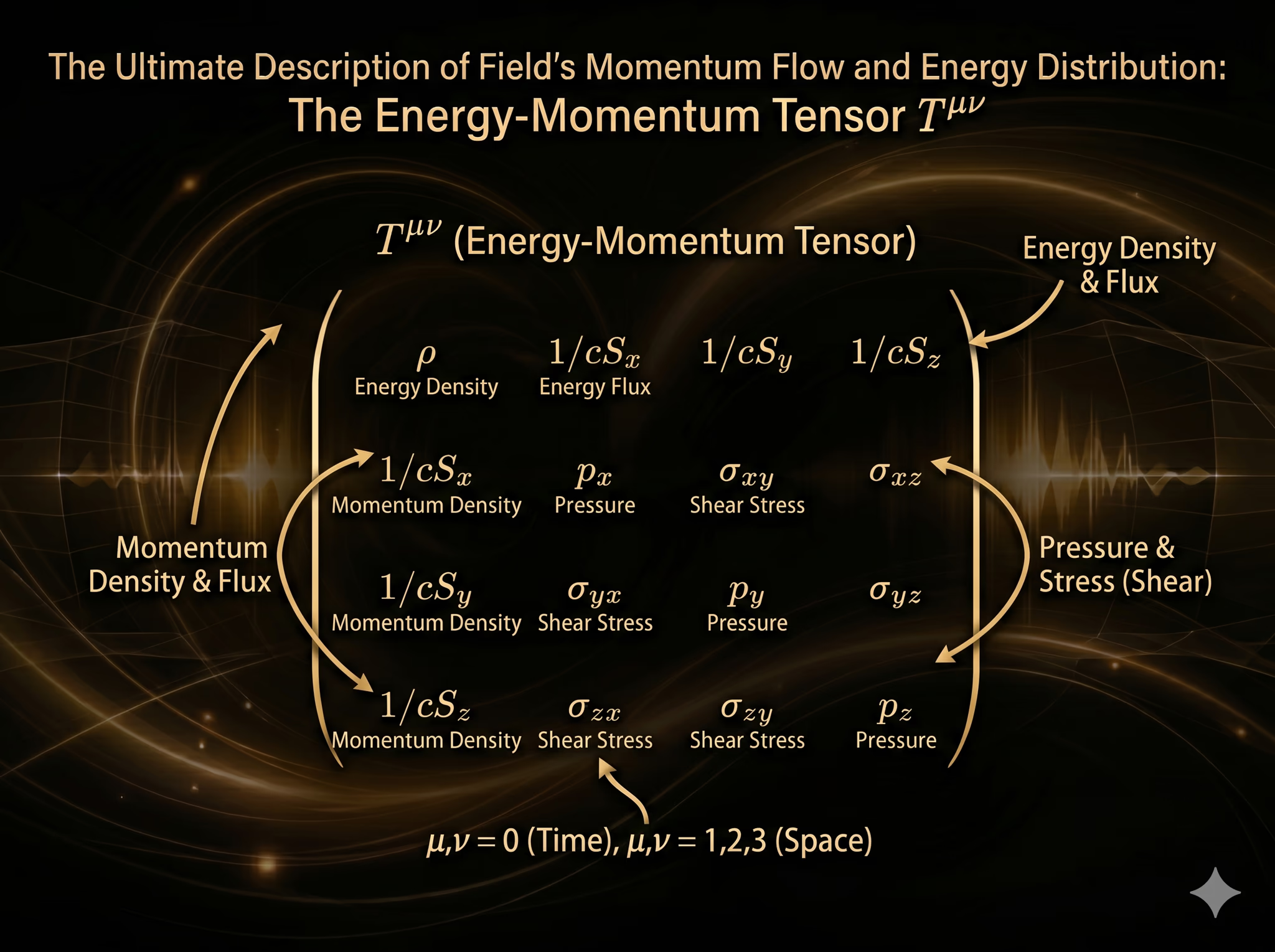
The stress-energy tensor records energy density, momentum density, energy flux, and stress in one object. In common coordinate conventions, is the energy density; and encode energy flux and momentum density, with factors of depending on the coordinates used; and describes momentum flux, including pressure and shear stress.
For a closed matter-field system in flat spacetime, local conservation of the total stress-energy tensor is written . General relativity replaces this with the covariant relation , which does not by itself define a global total energy in an arbitrary curved spacetime. The tensor also sources curvature. In SI units, without a cosmological constant,
The metric determines free-fall geodesics, while curvature governs tidal relative acceleration between nearby geodesics. Gravity is therefore represented not as an instantaneous force in fixed space, but as dynamical spacetime geometry coupled to stress-energy.
5. Summary
Classical mechanics uses force to describe changes in a body’s momentum. Field theory explains those changes through local exchange and finite-speed propagation. Relativity unifies energy and momentum, and general relativity couples their local distribution to spacetime geometry. These are successive levels of description, each addressing a limitation of the preceding one.