Table of Contents
Core Concepts of Dynamics: From Classical Mechanics to General Relativity
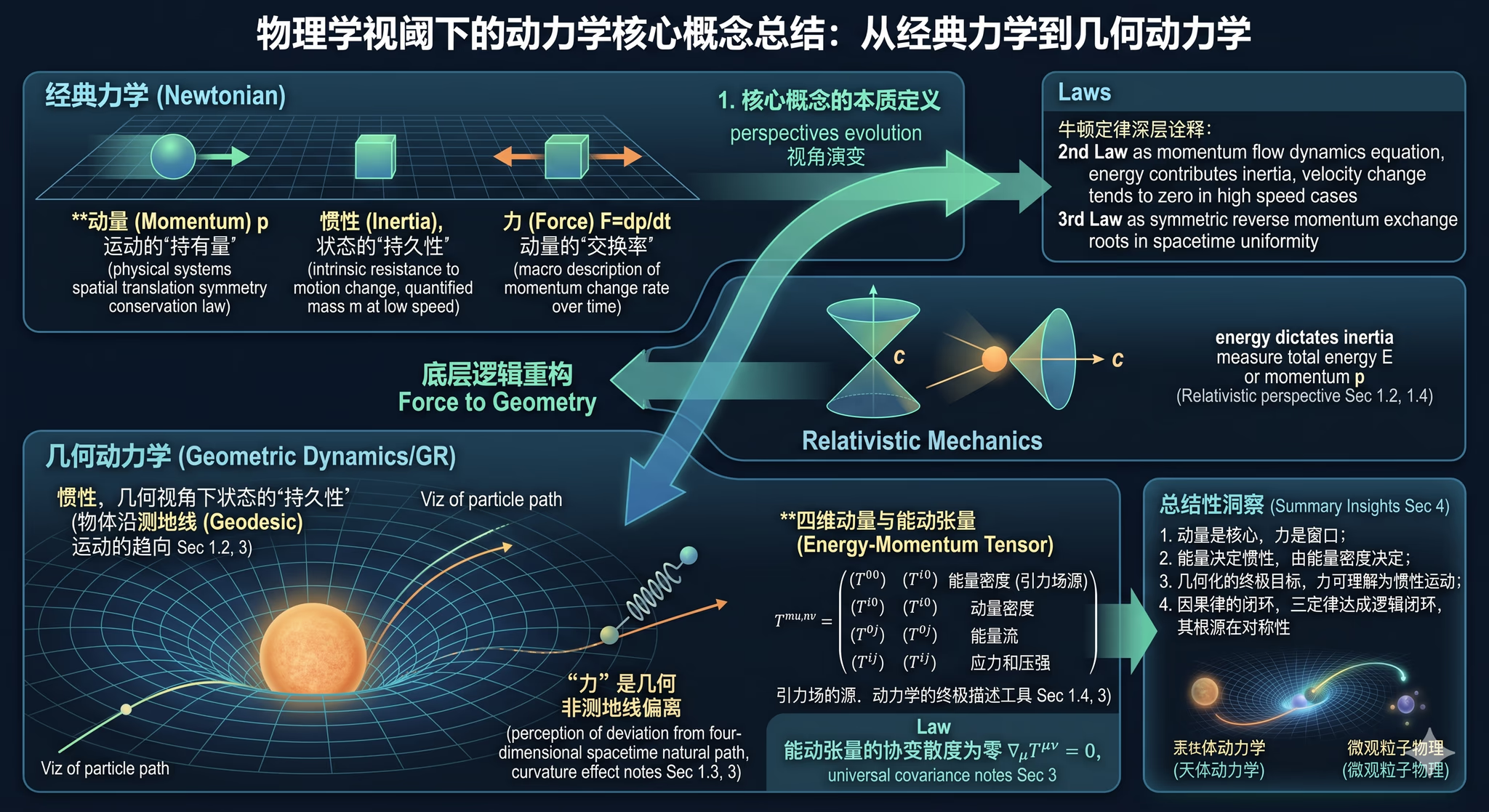
Dynamics studies how interactions change the state of matter and fields. Introductory mechanics often begins with force and acceleration, while more general formulations are organized around momentum, energy, and conservation laws. Force remains useful, but its role depends on the framework. The discussion below connects momentum, inertia, force, and stress-energy, and explains why is more general than the constant-mass, low-speed form .
1. Momentum
In non-relativistic mechanics, momentum is . For equal masses, a larger momentum requires a larger impulse to stop or redirect the body. More generally, if the action of an isolated system is invariant under spatial translations, Noether’s theorem gives conservation of total momentum.
Interactions transfer momentum. In a simple two-body collision where field momentum need not be tracked explicitly, one body’s gain is the other’s loss. For field-mediated interactions, the field can also carry momentum and must be included in the total. The relation therefore describes both the net force on a subsystem and its rate of momentum exchange with its surroundings.
2. Inertia
Inertia is the tendency to maintain a state of motion. In classical mechanics, inertial mass sets the proportionality between force and acceleration: under the same force for the same duration, a larger mass undergoes a smaller change in velocity. The same mass also appears in , linking momentum, force, and acceleration.
In relativity, rest mass remains invariant, but momentum becomes and total energy is , where . Decomposing the laboratory three-force relative to the instantaneous velocity gives and . Force and coordinate acceleration are therefore no longer related by a velocity-independent factor. As approaches , accelerating a massive particle requires increasing energy, and no finite energy can bring it to light speed.
3. Force
In Newtonian mechanics, net force is defined by . It reduces to only for constant mass with non-relativistic momentum. Lagrangian mechanics and field theory can instead begin with interaction terms in the potential or action and derive the corresponding force from the equations of motion. Force is an important description of interaction, but it is not the starting variable in every formulation.
General relativity extends inertial motion to geodesic motion in curved spacetime. A massive body subject to no non-gravitational force follows a timelike geodesic; support and electromagnetic forces move its worldline away from a geodesic and produce proper acceleration. An accelerometer held at rest on the ground reads nonzero, while an ideal freely falling accelerometer reads zero locally. Tidal effects cannot be removed by a coordinate choice because they are determined by curvature.
4. Energy-momentum
For a particle, relativity combines energy and three-momentum into four-momentum . It transforms covariantly between inertial frames, allowing collisions, decays, and radiation to be described by frame-independent four-momentum conservation. A photon has zero rest mass but nonzero four-momentum, with .
For continuous matter and fields, the corresponding object is the stress-energy tensor . Its components describe energy density, energy flux, momentum density, pressure, and shear stress. In SI units, without a cosmological constant, it enters Einstein’s equation as . Newtonian mass density is thereby generalized to the full distribution of energy, momentum, and stress.
5. Where Newton’s laws sit in the whole picture
Newton’s second law describes how the momentum of one body changes. For instantaneous pairwise interactions in classical mechanics, the third law makes the two forces equal and opposite, preserving the sum of the two mechanical momenta. In electromagnetic and other field-mediated interactions, the mechanical forces on two bodies need not be equal and opposite at the same instant; the field can carry the difference. The general statement is conservation of the total momentum of matter and fields when the isolated system has spatial-translation symmetry.
The table summarizes how the same questions are organized in three frameworks: how a state is represented, how interaction changes it, and what the complete system conserves.
| Item | Newtonian mechanics | Special relativity | General relativity |
|---|---|---|---|
| Measure of inertia | Mass relates force and acceleration | Rest mass invariant; relativistic relation between and | Free fall follows geodesics; non-gravitational force produces proper acceleration |
| Role of force | Rate of change of four-momentum | Non-gravitational four-force moves a worldline away from a geodesic | |
| Conservation | Separate momentum and energy | Four-momentum conservation | |
| Spacetime structure | Absolute, flat | Minkowski spacetime | Curved spacetime, dynamical |