In physics, the central objective of kinematics is to quantitatively describe the spatial evolution of an object over time. To construct this geometric framework, a series of time derivatives is introduced: starting from the fundamental position , its first time derivative defines velocity , which captures the instantaneous rate and direction of motion. The first derivative of velocity (the second derivative of position) defines acceleration , which measures the intensity of changes in the state of motion.
However, continuing up this chain of calculus reveals a specific phenomenon: whether in kinematic equations describing pure geometric motion or in the core dynamical equations investigating the underlying causes of motion, jerk (the third derivative of position, ) and the time derivative of force () rarely appear. Consequently, even higher-order kinematic derivatives—such as the fourth derivative of position (often termed snap or jounce in engineering), and higher-order force derivatives like yank and tug—are virtually absent from fundamental theories.
The absence of higher-order derivatives in fundamental equations is not due to mathematical undefinability. Rather, it is strictly dictated by the geometric structure of physical laws, the mathematical closure of dynamical systems, and the fundamental nature of physical interactions. This can be analyzed across the following dimensions:
1. Second-Order Closure of Dynamical Equations
A primary mandate of physics is predicting future motion based on a system’s current state. According to Newton’s second law, the equation of motion for a particle with constant mass is:
In classical mechanics, fundamental interactions in nature (such as gravitation, electrostatics, and Lorentz forces) are intrinsically functions of the current spacetime configuration and state of motion, i.e., . Substituting this into the equation of motion yields:
Mathematically, this constitutes a system of second-order ordinary differential equations. According to the Picard–Lindelöf theorem regarding existence and uniqueness, provided satisfies a local Lipschitz condition, completely determining the unique solution to this equation requires a total of independent initial conditions (where is the number of physical degrees of freedom). These independent variables typically manifest in two configurations:
- Cauchy Problem (Initial Value Problem): Corresponds to forward causal evolution, where initial position and initial velocity are given at the same initial moment. This forms the deterministic framework of classical mechanics.
- Boundary Value Problem: Corresponds to providing boundary positions and at both ends of a spacetime path. This forms the variational framework of Hamilton’s principle (the principle of stationary action) in analytical mechanics.
If the fundamental dynamical equation were artificially rewritten as a third-order differential equation concerning the rate of change of force, predicting future motion would require providing the initial acceleration as an additional, independent initial condition. However, in physical reality, acceleration is not an independent initial degree of freedom; its initial value is already fully determined by the intrinsic field function:
Once and are established in a Cauchy problem, the initial acceleration is implicitly fixed. Introducing third-order derivatives (jerk) provides no new independent physical information and disrupts the self-consistent order of the dynamical equations. Second-order spacetime derivatives achieve complete structural closure for describing states of motion, both mathematically and physically.
2. Phase Space Geometry and Hamiltonian Mechanics
Analytical mechanics (Lagrangian and Hamiltonian mechanics) reveals the deeper geometric origins of the second-order nature of dynamical equations.
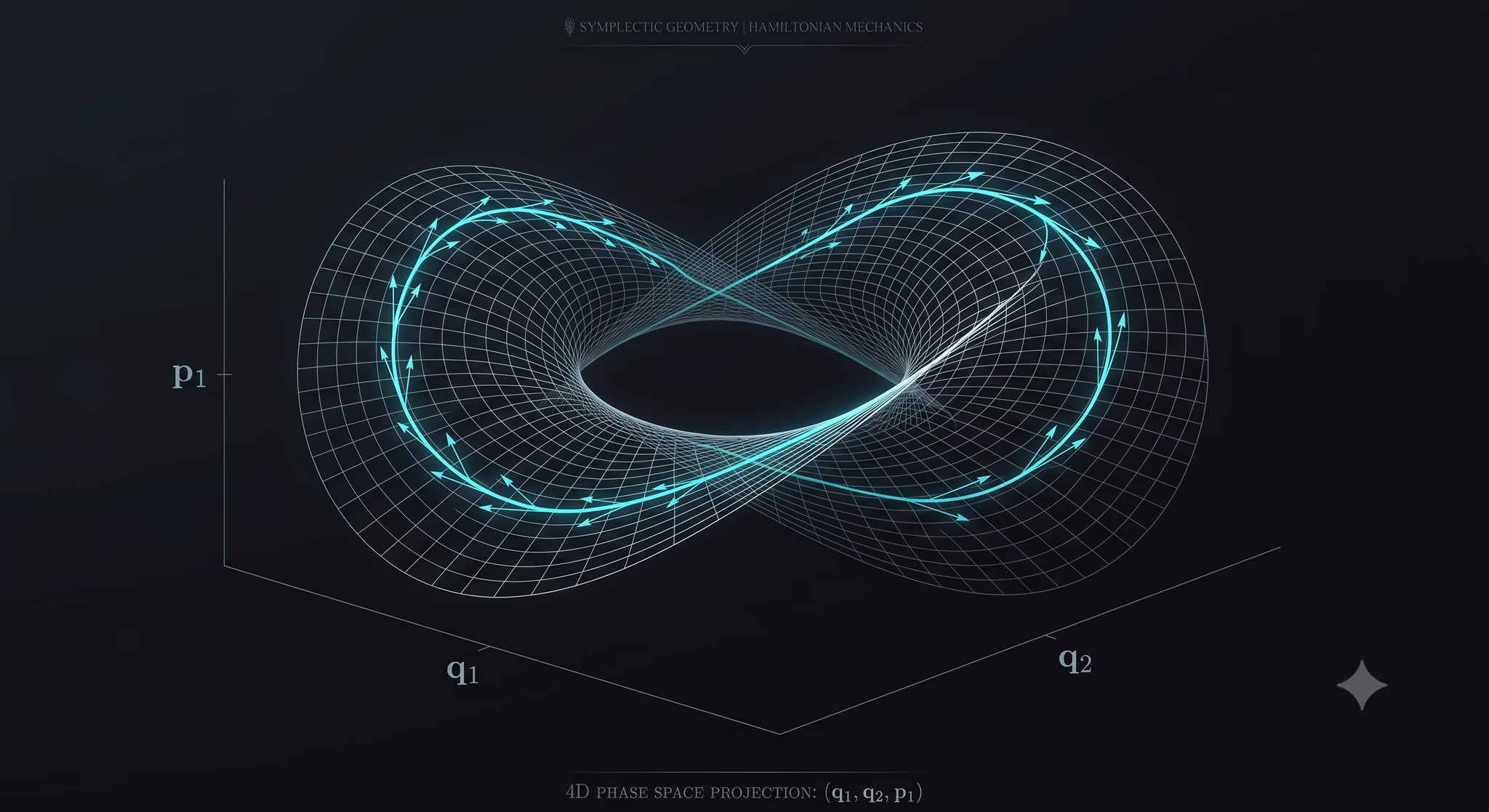
In the Hamiltonian formalism, the state of a mechanical system is completely characterized by its generalized coordinates and generalized momenta , which together construct the system’s phase space. Hamilton’s canonical equations:
constitute a system of first-order ordinary differential equations regarding the state variables . Phase space inherently possesses a symplectic geometry structure, and its dimensionality must be exactly .
Given a current point in phase space, the system’s subsequent time-evolution trajectory is uniquely determined on the symplectic manifold. Acceleration, jerk, and the rate of change of force are not state variables within this geometric representation; they are higher-order derivatives of the tangent vectors to the trajectory. Forcing jerk to be an independent state variable would necessitate expanding the phase space dimensionality (introducing independent acceleration axes), which would fundamentally destroy the symplectic structure of Hamiltonian mechanics.
This first-order/second-order consistency is not limited to classical mechanics. In quantum mechanics, the Schrödinger equation is similarly first-order in time, with the system’s state fully determined by the wave function in Hilbert space.
3. The Nature of Force: Fields and Local Instantaneous Response
From the perspective of modern field theory, force is the macroscopic manifestation of interactions between fields and matter. The force experienced by an object depends entirely on its spacetime coordinates and state of motion within the field.
In static fields (e.g., electrostatic or static gravitational fields), the force depends solely on the object’s current spatial configuration. When the field source itself moves or the external field evolves over time, constrained by the causal limits of special relativity (the speed of light), the interaction experienced at a field point at time is governed by retarded potentials. This implies the force depends on the field source’s configuration at a retarded time . Yet, for the object experiencing the force at a specific spacetime point, the force remains an instantaneous response to its local configuration and motion state at that exact moment: .
When an object moves through a non-uniform field that is also evolving over time, the force it experiences changes. Using the chain rule of multivariable calculus, the total time derivative of the force can be rigorously expanded as:
Here, the convective term reflects the change in force resulting from the object moving with velocity through a spatially non-uniform field, while the local term reflects the explicit temporal evolution of the field intensity at that specific spatial location.
Given that can be directly derived from the current position, velocity, and known field equations, it fundamentally lacks the necessity to be constructed as an independent dynamical quantity in basic theory.
4. Practical Application Scenarios for Higher-Order Derivatives
Although jerk and the time derivative of force are excluded as fundamental dynamical quantities in theoretical physics, they are critical metrics in applied physics, engineering kinematics, and microscopic radiation theory:
- Biomechanics and Human Comfort: The human body can adapt to high, constant acceleration (such as the sustained -forces experienced by fighter pilots) but is highly sensitive to the temporal rate of change of acceleration (jerk). High jerk indicates that the applied force changes violently within a millisecond timeframe, preventing muscles and skeletal structures from providing kinetic buffering. This leads to internal organ concussions or cervical spine injuries (e.g., the “whiplash effect” in rear-end collisions). Consequently, jerk is a strict core constraint in the trajectory planning for high-speed rail, elevators, and roller coasters.
- Mechanical Dynamics and Structural Fatigue: In the motion planning of precision CNC machine tools and industrial robotic arms, if the rate of change of force approaches infinity (corresponding to a step change in acceleration), the inherent structural elasticity will excite high-frequency resonance. This causes mechanical vibration, degradation of machining precision, and accelerated fatigue failure of materials.
- Self-Interaction in Electrodynamics (Abraham-Lorentz Force): In classical electrodynamics, an accelerating charge continuously dissipates free electromagnetic waves. To satisfy the conservation of energy, an equivalent recoil damping force—the radiation reaction force—must be introduced into the charge’s equation of motion:
This force is directly proportional to the time derivative of acceleration (jerk), marking one of the extremely rare scenarios in theoretical physics where a third-order derivative must be explicitly introduced. However, this formulation (the Abraham-Lorentz equation) yields classical paradoxes such as “pre-acceleration” (where the object begins accelerating before the force is applied), violating non-relativistic causality. This signals that classical electrodynamics has reached its theoretical limit here, necessitating corrections from Quantum Electrodynamics (QED) at smaller, microscopic scales.
Conclusion
Physics does not treat jerk or the rate of change of force as core subjects of fundamental study because the basic physical laws of nature achieve complete mathematical and physical closure at the second-order differential. Force determines the second derivative of position, and force itself is determined by position, velocity, and time. This self-consistent causal chain forms the definitive bedrock of the entire edifice of classical physics.