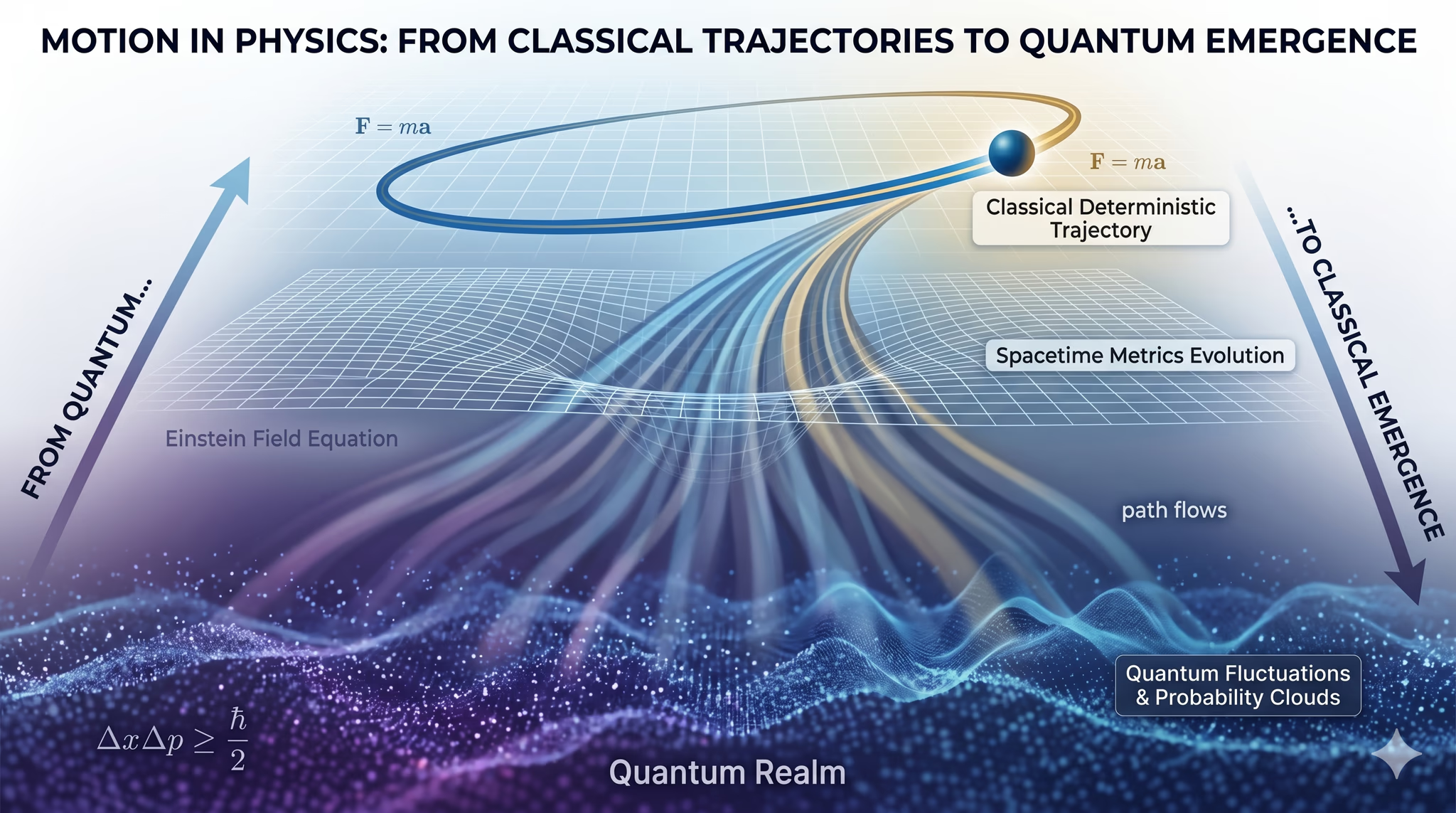
The physical understanding of the world often begins with the most ordinary phenomena, among which “motion” is arguably the most central. In everyday contexts, the word “motion” encompasses a rich variety of meanings: it could refer to changes in social structures (such as social movements), physical exercise for health, or the bustling traffic of the morning commute. These everyday forms of “motion” usually carry subjective intentions or complex social attributes.
However, when we strip away these external attributes and attempt to re-examine the fundamental logic of the material world using rigorous scientific language, we find that the seemingly simple question of “what is motion” actually touches upon the deepest laws governing the universe.
Below, we will proceed from the intuitive realm of classical physics, extending all the way to the frontiers of gravity, cosmology, and quantum field theory, to explore the true nature of “motion” across different physical contexts.
I. What is Motion? — From Intuition to Rigorous Definition
Within the most fundamental framework of physics, we must first eliminate the ambiguity of everyday language. Mechanical motion is strictly defined as: the change in spatial position of one object relative to another over time.
This definition contains three indispensable core elements:
- Space and Time: Motion must unfold on the stage of space and time. To describe this change objectively and accurately, physicists introduced three progressively advanced concepts:
- Displacement: The change in position, incorporating both magnitude and direction (describing the span and direction of the change).
- Velocity: The rate of change of position.
- Acceleration: The rate of change of velocity (this is also the core bridge connecting “kinematics,” which purely describes motion, and “dynamics,” which investigates its causes, thereby revealing the relationship between force and changes in the state of motion).
- Reference Frame: Motion is absolute, but the description of motion is relative. Sitting on a high-speed train moving at a constant velocity, you are stationary relative to the carriage; but relative to the ground, you are moving at high speed. There is no “absolute rest” in the universe independent of a reference frame.
- Continuity and Trajectory: In classical cognition, motion is not only continuous but also possesses a distinct trajectory.
II. The Context of Classical Mechanics: Deterministic Trajectories and the Bedrock of Engineering
In the macroscopic, low-speed (far below the speed of light) world, Newtonian mechanics governs the laws of motion. Motion in this framework is highly predictable, and its forms can be reduced to a combination of three basic types: translation (where all points of the object have the same displacement), rotation (spinning around an axis), and vibration (oscillating around an equilibrium position).
We typically break down motion in classical mechanics into two levels of study:
- Kinematics: Responsible for “describing” motion, it concerns only the pure geometric relationships among displacement, velocity, and acceleration, without delving into the causes of the motion.
- Dynamics: Responsible for “explaining” motion. Through Newton’s Second Law (), it links the mass of an object, the external forces acting upon it, and the resulting acceleration. Force is not the cause of maintaining motion; force is the cause of changing an object’s state of motion. As long as we know an object’s initial state and the forces applied to it, we can precisely predict its every future position.
Applications: Classical mechanics is the foundation of modern engineering. From the curvature design of high-speed rail tracks and the stress analysis of bridges, to the calculation and orbital maneuvers of spacecraft (such as Hohmann transfers), and even the MEMS gyroscopes in our smartphones, all are built upon the precise mastery of translational, rotational, and vibrational laws at this scale.
III. The Context of Thermodynamics: Microscopic Disorder and Macroscopic Order
When our focus shifts from a single macroscopic object to a drop of water or a canister of gas, the context of motion changes. A seemingly still glass of warm water internally hosts the violent, random motion of countless water molecules, known as thermal motion.
Here, tracking the classical trajectory of every single molecule is both impossible and meaningless. Physics thus undergoes a perspective shift: adopting the methods of statistical mechanics to focus on the average effects of group motion. Macroscopic properties like “temperature” and “pressure” are essentially statistical averages of the intensity of thermal motion and momentum exchange of microscopic particles. This represents a pragmatic pivot from absolute determinism to probability and statistics.
Applications: The development of internal combustion and aero engines, the evolutionary forecasting of global climate models, and the design of chip cooling systems all rely heavily on the application of the collective thermal motion laws of massive numbers of microscopic particles.
IV. The Context of Classical Field Theory: “Ripples” Diffusing in Space
With the development of electromagnetism and theories of gravity, it was discovered that “tangible matter” is not the only thing capable of motion. Space itself is filled with an invisible, intangible, yet truly existent physical reality—the field.
In classical field theory, a field assigns a mathematical quantity (scalar, vector, or tensor) to every point in spacetime. At this point, “motion” is no longer the displacement of an isolated ball, but rather the evolution and propagation of the field’s values in spacetime. When charged particles accelerate, the electromagnetic field oscillates and propagates outward at the speed of light, forming electromagnetic waves; when massive celestial bodies undergo violent acceleration (such as binary black hole mergers), perturbations in spacetime curvature also propagate outward, forming gravitational waves.
Applications: The laws of motion in classical field theory directly birthed the modern information society. Mobile communications, Wi-Fi, radar, and satellite navigation essentially utilize the “motion” of this material form—the electromagnetic field—to transmit energy and information.
V. The Context of Relativity: The Weaving of Spacetime and the Evolution of the Metric
When an object’s speed approaches the speed of light, or when it resides in an extremely strong gravitational field, physics naturally transitions into the context of relativity. Here, motion is no longer merely “an object moving through space over time”; rather, motion itself alters the metric of space and time.
- Time Dilation and Length Contraction: Relative to a stationary observer, time flows more slowly for a high-speed moving object, and its length contracts along the direction of motion.
- The Principle of Invariant Light Speed: No matter how fast an observer chases a beam of light, the measured speed of light in a vacuum, , remains forever constant. This constitutes the ultimate speed limit for all local motion in the universe.
Taking it a step further, in general relativity, exploring the essence of motion requires introducing two core entities: the metric field and the energy-momentum tensor.
- Four-Dimensional Spacetime and the Metric Field: Time and space are no longer separate static backgrounds, but fuse into an elastic “four-dimensional spacetime.” Physics uses the metric field to precisely describe the geometric structure of this spacetime.
- The Motion of Matter as the Flow of the Energy-Momentum Tensor: The existence and motion of tangible matter and non-gravitational fields (like the electromagnetic field) are uniformly characterized as the distribution and flow of the energy-momentum tensor in spacetime.
- Independent Evolution and Mutual Coupling: It must be distinguished that both the metric field and the energy-momentum tensor of matter can possess their own independent “motion.” Matter has its own laws of flow; meanwhile, the metric field itself is a dynamical entity. Even in an absolute vacuum completely devoid of matter, the metric field can still evolve independently (e.g., the propagation of gravitational waves).
In the vast majority of real physical scenarios, the “motions” of these two are closely intertwined. As physicist John Archibald Wheeler incisively summarized: “Matter tells spacetime how to curve, and spacetime tells matter how to move.” This is general relativity’s most piercing insight into gravity and motion.
VI. Cosmological Distinction: Is the Accelerated Expansion of Space “Superluminal” Motion?
After clarifying the speed limit of relativity, a highly deceptive question naturally arises: Astronomical observations indicate that the universe is undergoing accelerated expansion, and the recessional velocities of sufficiently distant galaxies have far exceeded the speed of light. Does this violate relativity? Does this expansion count as “motion” in the traditional sense?
The answer is: It does not violate relativity, because the expansion of space is fundamentally different from the local motion of objects within space.
- Metric Expansion vs. Local Motion: According to Hubble’s Law (), the recessional velocity of a galaxy is proportional to its distance. This phenomenon is not the galaxies themselves possessing immense kinetic energy and “traveling through” space, but rather the spatial metric between the galaxies itself stretching. It is like drawing dots on the surface of an expanding balloon; the dots themselves do not crawl across the surface, yet the distances between them recede at a rate exceeding any set limit.
- The Scope of the Light Speed Limit: The principle of insurmountable light speed in special relativity strictly applies only to local Lorentz frames. That is, within the same local space, a galaxy flying past you can never exceed the speed of light. However, under the framework of general relativity, the expansion rate of space itself between two widely separated comoving reference frames is not restricted by the speed of light.
Therefore, strictly speaking, the accelerated expansion of the universe does not belong to the “relative motion of objects against a spacetime background” found in traditional mechanics, but is rather the dynamical evolution of the spacetime background itself.
VII. The Context of Quantum Field Theory: Probability Clouds and the Boiling Vacuum
When we delve into extremely microscopic scales, the core concept of motion in classical physics—the “trajectory”—completely fails.
- Wave-Particle Duality: When an electron moves, it is no longer a classical “solid little ball”; it simultaneously exhibits the properties of a particle and the dispersive attributes of a wave.
- Heisenberg Uncertainty Principle: We fundamentally cannot precisely measure the position and momentum of a microscopic particle simultaneously (). The more accurately the position is measured, the fuzzier our knowledge of its momentum becomes, and vice versa.
- Probability Clouds: In the quantum context, motion is no longer a continuous line. Electrons do not “fly in orbits” around the atomic nucleus, but exist in space in the form of “probability clouds.” We can only calculate the probability of it appearing at a certain point in space at a certain moment, but we cannot say it “is moving from point A to point B.”
Furthermore, quantum field theory, which combines quantum mechanics and special relativity, provides the ultimate picture of matter and motion. There are no absolutely isolated “elementary particles” in the universe. So-called electrons and photons are merely quantized excitations generated when the omnipresent “electron field” or “electromagnetic field” is stimulated.
- At this point, the “motion of particles” is essentially the propagation and interaction of excited states within the field, much like a surging stadium wave in an audience, where the wave moves, but individual people do not run laterally. The smooth, deterministic classical trajectories we see in the macroscopic world are essentially macroscopic manifestations emerging from the interactions of a vast number of underlying quantum states.
- Even in an absolute vacuum completely devoid of tangible particles, the quantum field is not dead silent. Constrained by the uncertainty principle, the vacuum constantly undergoes quantum fluctuations, with virtual particle pairs continuously being created and instantly annihilating. This “boiling of the vacuum” is the most fundamental and eternal “motion” at the microscopic scale.
Applications: The laws of motion in quantum mechanics and quantum field theory form the core of modern high-tech. The tunneling of electron probability clouds in semiconductor transistors, the stimulated emission in lasers, nuclear magnetic resonance, and even the booming field of superconducting quantum computers, are all direct manipulations of microscopic laws of motion.
Conclusion
From the intuitive feelings of daily life to the deterministic trajectories of the Newtonian era, onward to the evolution of the spacetime metric in general relativity, and finally to the emergence of macroscopic trajectories from underlying quantum laws, humanity’s understanding of “motion” has undergone a long journey. The development of physics has not completely overthrown the past, but rather continuously defines the boundaries of applicability for older theories. Whether launching macroscopic spacecraft, probing early cosmic evolution, or manipulating microscopic qubits, the pragmatic nature of science lies exactly in this: accurately applying the corresponding laws in different scales and contexts to understand and transform the world.
Note: The core physical logic and structural outline of this article were independently developed by the author, while the language refinement and illustrations were assisted by AI tools.