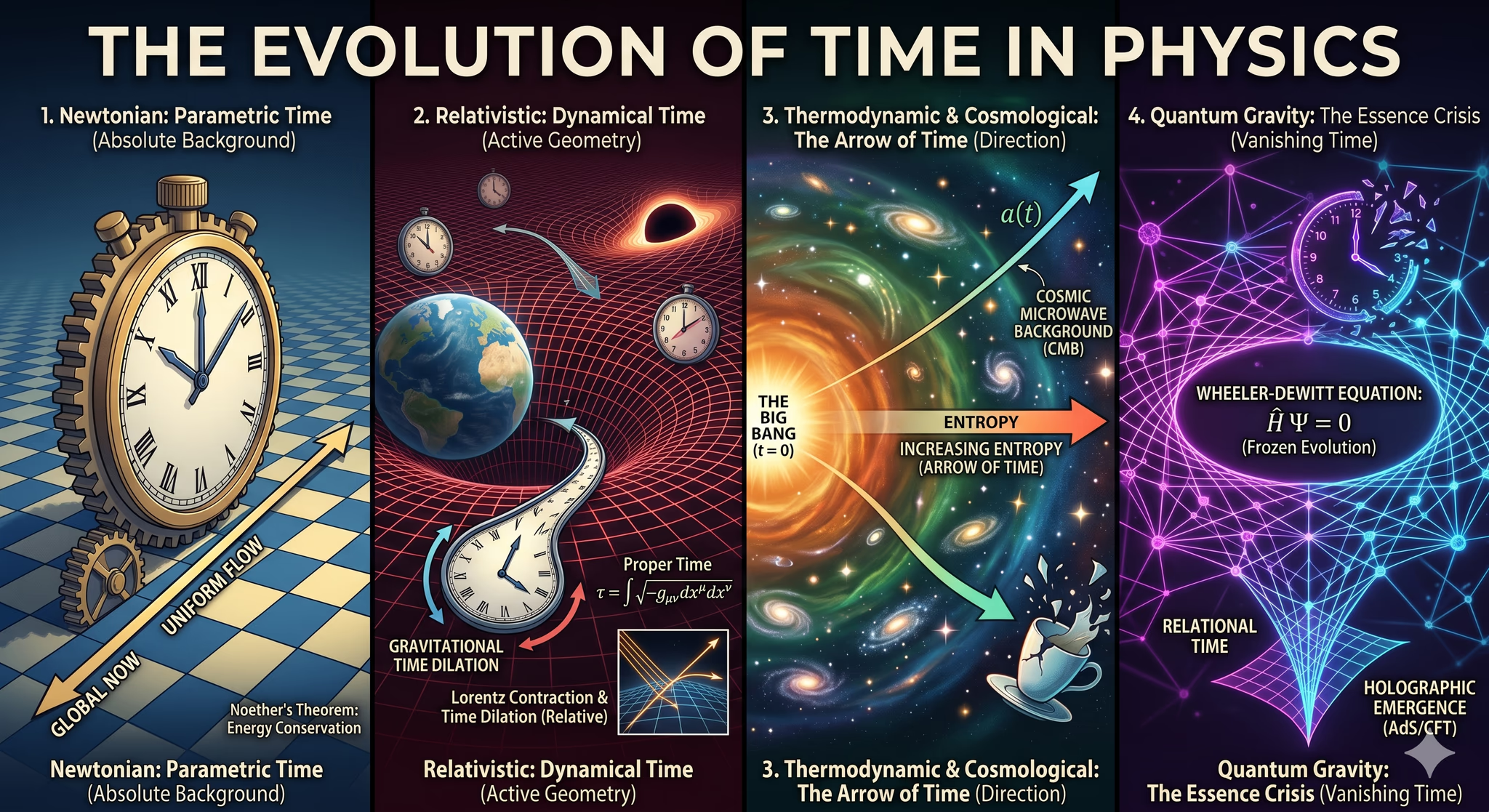
The evolution of how physics understands “time” is essentially a conceptual reconstruction that continuously shatters human intuition. From classical mechanics to relativity, and further into thermodynamics and quantum gravity, time has transitioned from an absolute background parameter to a geometric entity with physical dynamical effects, and ultimately faces the profound question of whether it “truly exists” in the most cutting-edge theories.
This evolutionary process can be clearly divided into four core stages:
I. Classical Mechanics: “Parametric Time” as an Absolute Background
In the classical mechanics framework constructed by Newton, time is defined as absolute, mathematical, and unidirectionally flowing. Time is treated as a rigid background structure (a one-dimensional base manifold), providing the universe with a unique and absolute foliation.
In his Principia, Newton proposed that absolute time flows equably without regard to anything external. Under this framework:
- Global Nature of Time: The entire universe shares a single absolute clock. Regardless of an observer’s state of motion, “now” is universal for everyone.
- Status in Equations: Time is merely a monotonically increasing external evolution parameter. In Newton’s second law, , time is the metric for spatial variation. According to Noether’s theorem, this time-translation symmetry guarantees the conservation of energy of the system. Here, the motion of matter unfolds on the stage of time, but never reacts back upon the metric of time itself.
II. The Relativistic Revolution: “Dynamical Time” as an Active Geometry
Einstein’s theory of relativity completely dismantled the rigid background concept of time. Time is no longer an independent ruler but is woven together with space into a physical reality characterized by locality and dynamics.
1. Special Relativity: The Breakdown of Simultaneity and Causal Partial Order
The principle of the constancy of the speed of light shattered Newton’s global time. Time and space are unified into a four-dimensional Minkowski spacetime, where the spacetime line element remains invariant under Lorentz transformations. In this framework, time exhibits a duality:
- Coordinate Time: This is merely a label on the manifold, dependent on the observer’s choice of reference frame. The time dilation effect is precisely the manifestation of the relativity of coordinate time.
- Proper Time: The true physical observable obtained by integrating along an observer’s worldline. A universe-wide “simultaneity” ceases to exist; the only absolute is the causality strictly constrained by the light cone structure.
2. General Relativity: A Dynamical Variable in the Gravitational Field
General relativity further posits that spacetime is not only unified but also malleable. General covariance makes coordinate time, in a sense, a gauge freedom.
- Gravitational Time Dilation and Metric Coupling: Deeper in a gravitational potential well (where spacetime curvature is greater), the flow of time slows down. In general relativity, proper time is no longer a constant but is directly determined by the local dynamical metric tensor .
- Background Independence: Matter tells spacetime how to curve, and spacetime tells matter how to move. Time is no longer a flat stage but a protagonist participating in physical evolution. In a general curved spacetime, there isn’t even a global “standard time” unless the spacetime itself possesses highly specific symmetries.
III. Thermodynamics and Cosmology: The Macroscopic Arrow of Time
Although relativity profoundly geometrizes time, fundamental physics equations at the microscopic level (whether Newtonian mechanics, electromagnetism, or the Schrödinger equation in quantum mechanics) are essentially symmetric under time reversal (). The unambiguous unidirectionality of time in reality (the arrow of time) is entirely a macroscopic and cosmological emergent phenomenon.
- The Thermodynamic Arrow of Time: Dominated by the second law of thermodynamics and based on Boltzmann’s statistical mechanics, a system always tends to evolve towards a macroscopic state with a larger number of microstates (the direction of increasing entropy). The fact that we remember the past but not the future is fundamentally because the universe was in a highly exceptional low-entropy state in the past.
- The Cosmological Arrow of Time: The expansion of the universe provides a macroscopic direction of time evolution. In the FLRW metric describing a homogeneous and isotropic universe, we can use the Cosmic Microwave Background (CMB) to define a global “Cosmic time” for all comoving observers. Accompanied by the expansion of the universe’s scale factor, it has evolved from at the Big Bang to the present, providing a macroscopic, one-way spacetime metric.
IV. Quantum Mechanics and Quantum Gravity: The Fundamental Crisis of Time
When attempting to push the concept of time to the microscopic extreme, causing the dynamical time of relativity to collide with the formalism of quantum mechanics, physics encounters a deep, unresolved contradiction: “The Problem of Time.”
- The Time Parameter in Quantum Mechanics: In standard quantum mechanics, time regresses to a status similar to the Newtonian era. Constrained by Pauli’s theorem, time cannot be an observable Hermitian operator like position or momentum. It remains merely an external evolution parameter, with the Hamiltonian operator driving the system’s evolution: .
- Quantum Gravity and “Frozen Evolution”: When physicists attempt to quantize general relativity (e.g., canonical quantum gravity), spacetime must undergo a 3+1 decomposition. Within this framework, the total energy of the system becomes a pure constraint. Acting on the wavefunction of the universe, this yields the Wheeler-DeWitt equation, . This implies that the overall quantum state of the universe does not evolve over time; the time parameter completely disappears from the most fundamental dynamical equation.
- Relationalism and Holographic Emergence: To resolve the dilemma of vanishing time, modern cutting-edge theories lean towards “relational time”—meaning external time does not exist, and what we call evolution is merely the relative change between intrinsic variables of the system (such as the cosmic scale factor). Furthermore, holographic perspectives like string theory or the AdS/CFT correspondence suggest that time itself might not be a fundamental physical degree of freedom at all. Instead, much like temperature or pressure, it may be a macroscopic statistical illusion “emerging” from a deeper geometry of quantum entanglement.
From an absolute external parameter to a relative dynamical geometry, and further to its dissolution in foundational physical laws and its emergence at the macroscopic scale, physics’ understanding of time remains a profound and unfinished exploration.
Note: The core physical logic and structural outline of this article were independently developed by the author, while the language refinement and illustrations were assisted by AI tools.