Table of Contents
Motion in Physics: From Classical Trajectories to Quantum Emergence
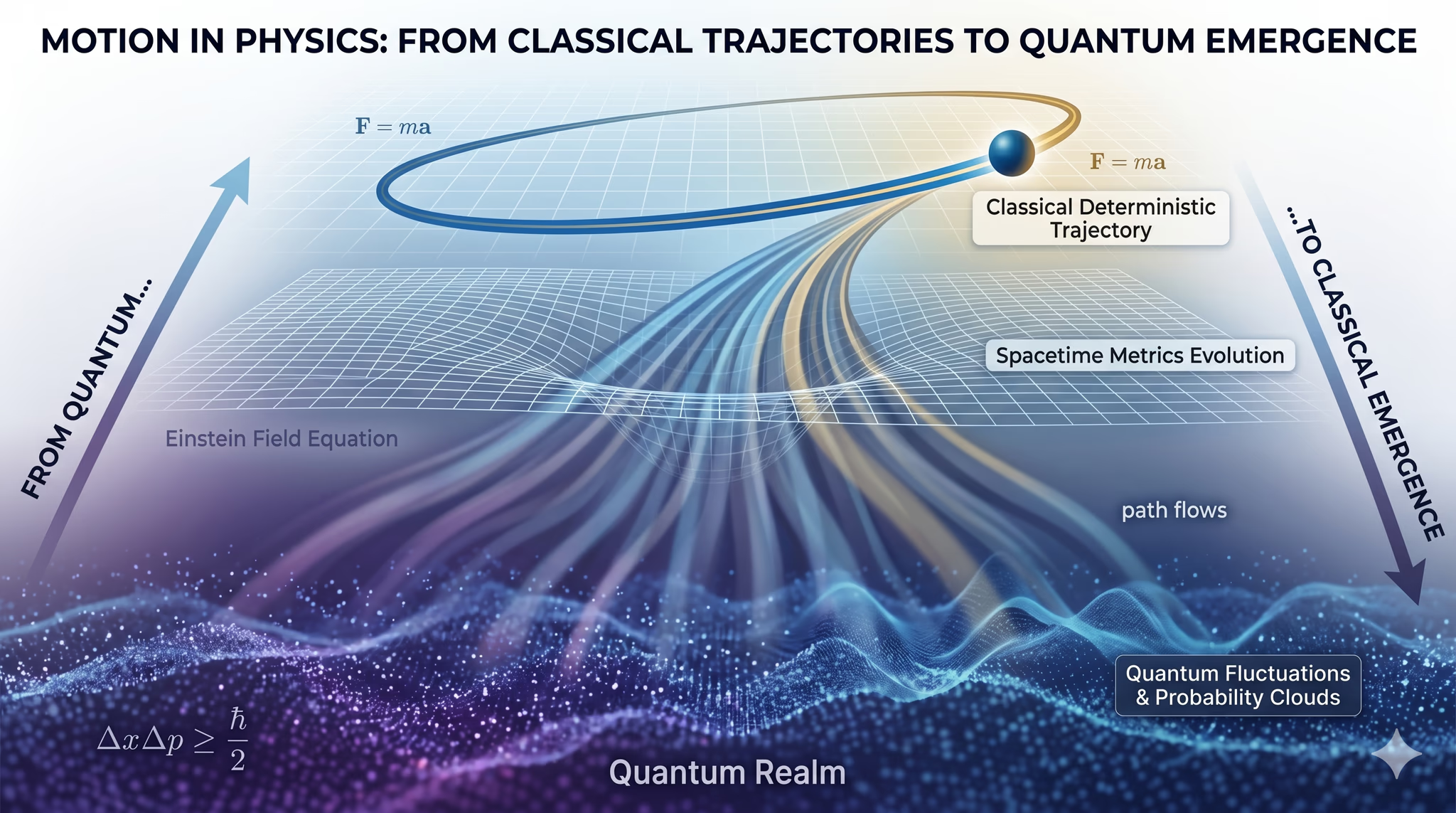
In classical mechanics, motion is a change of position relative to a reference frame, represented by a continuous trajectory. This definition assumes that the object has a definite position, time is a common evolution parameter, and the spatial background is fixed. Systems with many particles, relativistic speeds, strong gravity, or quantum scales require different state variables. The object that evolves may then be a statistical distribution, a field, spacetime geometry, or a quantum state.
1. Basic elements of mechanical motion
Mechanical motion begins with a reference frame and coordinates, followed by a position . Velocity and acceleration are its first and second time derivatives. The same body may be at rest relative to a train and moving relative to the ground, so any velocity or trajectory must be tied to a frame. In classical mechanics, initial data and an interaction law determine a continuous trajectory; later theories revise the frame, background, or status of that trajectory.
2. Classical mechanics
Newtonian mechanics is usually sufficient when bodies can be approximated as particles or rigid bodies, , gravity is weak, and quantum effects are negligible. Translation, rotation, and vibration combine to describe many mechanical systems.
Kinematics relates position, velocity, and acceleration. Dynamics adds , which becomes for constant mass at low speed. Initial position, initial velocity, and the interaction model then determine the trajectory. This framework accurately describes vehicles, structural motion, planetary orbits, and many spacecraft maneuvers within its domain.
3. Thermodynamics and statistical mechanics
A trajectory remains meaningful for an individual classical particle, but it is often the wrong variable for a many-body problem. Gases, liquids, and solids contain too many microscopic degrees of freedom to track one by one, and exact trajectories do not directly answer questions about temperature, pressure, or heat flow. Statistical mechanics instead evolves probability distributions, ensembles, and macrostates. Its microscopic basis may be classical or quantum; quantum statistics is essential for systems such as low-temperature solids and quantum gases.
4. Classical field theory
Fields extend motion beyond particle trajectories. The electromagnetic field has values throughout spacetime and evolves according to Maxwell’s equations. Charges alter the field, and the local field acts back on other charges. Accelerating charges can emit waves that continue to propagate and carry energy and momentum after leaving the source. Radio, radar, and antenna systems are therefore described through evolving field configurations rather than through a material object traveling from transmitter to receiver.
5. Relativity
Near light speed, absolute time and Galilean transformations fail. When gravity is significant, a fixed flat background also becomes inadequate. Relativity treats these two limits while recovering Newtonian mechanics at low speed and weak gravity.
Special relativity relates inertial frames by Lorentz transformations. Massive bodies cannot be accelerated to the invariant local vacuum speed , and their motion is described covariantly by worldlines, proper time, and four-momentum. General relativity makes the metric dynamical: stress-energy sources curvature, and the metric determines free-fall geodesics. In the weak-field limit, systems with a changing mass quadrupole or higher nonspherical multipole can radiate gravitational waves; uniform translation or strictly spherical motion does not.
6. Cosmic expansion and the speed limit
Cosmic expansion is an example of metric evolution. In a homogeneous and isotropic model, the scale factor changes the proper distance between comoving galaxies. Local motion remains subject to the speed limit , but sufficiently distant comoving galaxies can have recession rates greater than because recession is not motion through a fixed background. Hubble’s relation describes large-scale geometric expansion, not local superluminal travel.
7. Quantum mechanics and quantum field theory
At atomic scales, a classical trajectory is no longer fundamental. A quantum state is represented by a wave function or state vector, and position and momentum cannot both have arbitrarily precise values. An electron in an atom occupies an energy state or a superposition, from which the theory predicts probability distributions for measurements. It does not travel around the nucleus on a definite classical orbit.
Quantum field theory describes particles as excitations of quantum fields. Particle propagation is the evolution and interaction of quantum states; internal lines in perturbative Feynman diagrams, often called virtual particles, are not independently detectable classical particles. Through decoherence and the appropriate limits, localized states acquire stable, approximately classical behavior. Smooth macroscopic trajectories are therefore effective consequences of quantum dynamics rather than separate rules added to it.
8. Choosing a framework
The appropriate framework depends on the object, scale, speed, and gravitational field. Newtonian mechanics handles most vehicle and orbital calculations; statistical mechanics treats many-body thermal behavior; relativistic and quantum theories are needed for high-energy beams; general relativity describes black holes and cosmic expansion. Where their domains overlap, the theories must agree in the relevant approximation, and a more general theory must recover the earlier effective description in its limiting regime.
| Framework | Object of motion | Main conditions |
|---|---|---|
| Newtonian mechanics | Trajectories of point masses and rigid bodies | , weak gravity |
| Statistical mechanics | Macroscopic state of particle ensembles | Many bodies, thermal equilibrium or near equilibrium |
| Classical field theory | Propagation and evolution of field values | Electromagnetic fields, continua |
| Relativity | Material worldlines and metric evolution | or strong gravity |
| Quantum field theory | Propagation and interaction of field excitations | Microscopic, high energy |