Table of Contents
Four Stages of Time in Physics: From Parameter to Emergence
In ordinary use, time may mean a clock reading, a duration, or the order of events. Physics must also ask whether time is an external parameter or part of the dynamical system, how different observers compare intervals, and why macroscopic processes have a preferred direction. Classical mechanics, relativity, statistical physics, and quantum gravity revise different parts of that picture.
1. Classical mechanics: parametric time
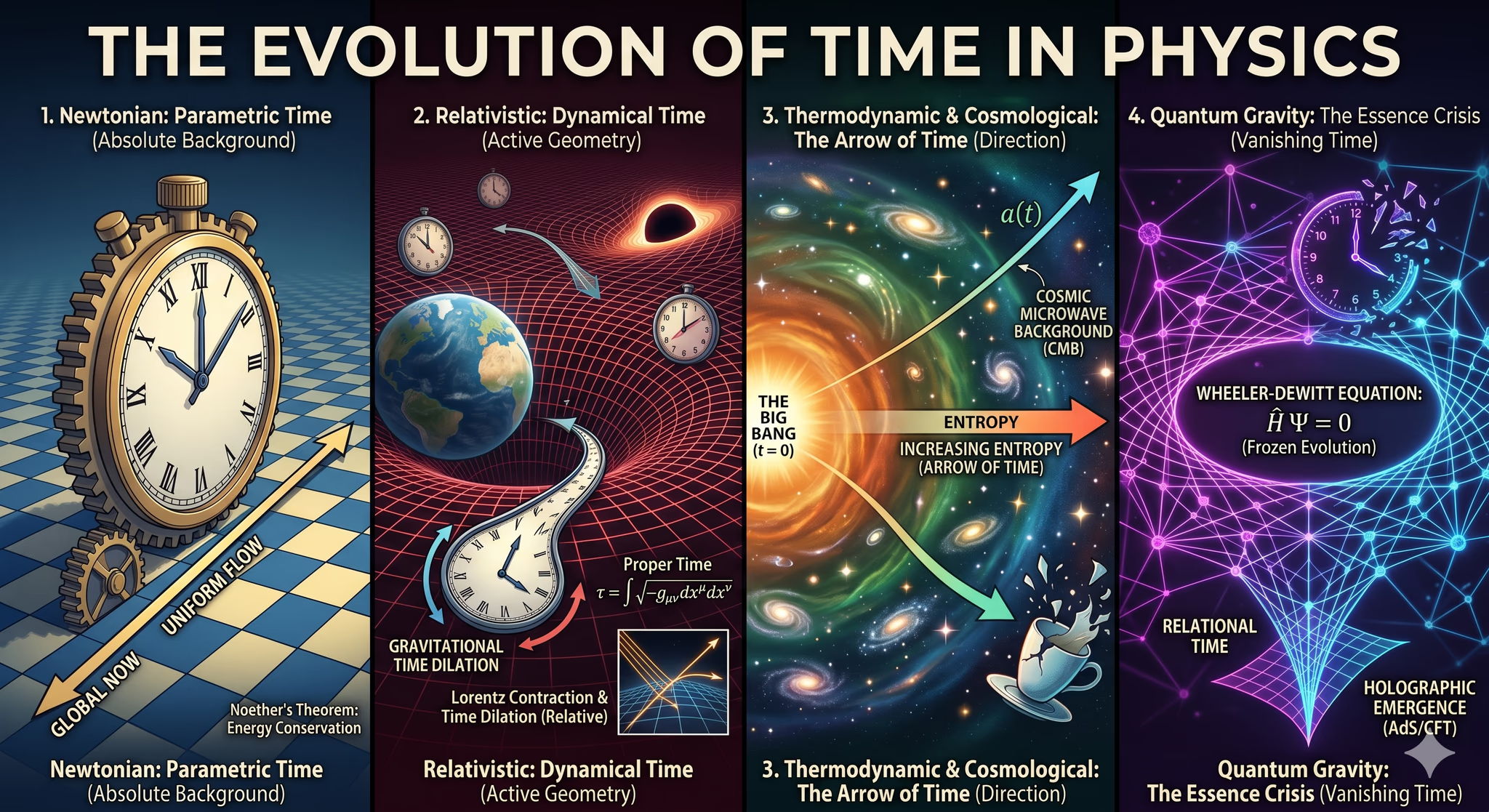
Newtonian mechanics treats time as a uniform global quantity independent of the state of matter. Galilean transformations satisfy , so all inertial observers share the same simultaneity and elapsed time. Space and time form a fixed background on which bodies move.
In , time is an external parameter that orders states but has no equation of motion of its own. If a system’s action is invariant under time translations, Noether’s theorem gives the corresponding conservation of energy. Classical time thus supplies both a universal event order and the parameter used to evolve the system.
Electromagnetism exposed the limits of this structure. Maxwell’s equations contain a characteristic vacuum speed and do not retain the same form under Galilean transformations. If electromagnetic laws are to hold in every inertial frame, time cannot remain wholly separate from space and identical for all observers.
2. Relativity: geometric time
Special relativity abandons absolute simultaneity and merges time with space into four-dimensional Minkowski spacetime. The line element
is invariant under Lorentz transforms between inertial frames—time is no longer the component that sits still in every transform, but participates on equal footing with spatial coordinates.
Relativity distinguishes coordinate time from proper time. Coordinate time depends on the frame and coordinate choice. Proper time is the interval recorded by an ideal clock along its own worldline and is invariant for that segment of the worldline. Two observers who separate and later meet can accumulate different proper times, while the meeting events and their causal relation remain the same for all observers. Light cones, not a universal present, determine which events can influence one another.
General relativity makes spacetime geometry dynamical. The metric determines lengths, proper times, and free-fall trajectories, and is coupled to matter and fields. In SI units, without a cosmological constant, . In a static weak field, a clock at lower gravitational potential runs more slowly than one at higher potential. GPS combines this effect with the special-relativistic correction from orbital motion.
An arbitrary curved spacetime has no natural, unique global time coordinate. Suitable symmetries can single out a useful time coordinate, and globally hyperbolic spacetimes admit global time functions, but neither restores Newtonian absolute time. Relativity explains how observers compare intervals and how matter affects spacetime measurement; it does not by itself explain the macroscopic distinction between past and future.
3. Thermodynamics and cosmology: macroscopic time direction
Many microscopic equations are time-reversal symmetric when velocities, momenta, magnetic fields, and related quantities are transformed appropriately. The weak interaction does violate time-reversal symmetry, but that violation does not explain the broad thermodynamic irreversibility of everyday processes. Broken cups do not spontaneously reassemble, and heat does not flow from cold to hot without another change. This is a statistical, not merely geometric, question.
Statistical mechanics relates each macroscopic state to many microscopic configurations. An isolated system overwhelmingly tends to evolve from a low-entropy macrostate with fewer compatible microstates toward one with more. This direction also depends on a low-entropy initial condition; nearly time-symmetric microscopic laws alone do not select it. Geometric time organizes events, while the thermodynamic arrow describes the statistical direction of macroscopic evolution.
Cosmology provides both a setting for that initial condition and a macroscopic clock. In the homogeneous and isotropic FLRW model, comoving observers use cosmic time to describe the scale factor and define relations involving age and redshift. This coordinate follows from large-scale symmetry; it is not a universal Newtonian time for arbitrary spacetimes. Time now has three distinct roles: an evolution parameter or coordinate, proper time along a worldline, and a macroscopic direction and scale.
4. Quantum mechanics and quantum gravity
Standard quantum mechanics still treats time as an external parameter. Schrödinger’s equation evolves a state with respect to , but time is not represented universally by a self-adjoint operator in the way position is. The argument often associated with Pauli shows that a Hamiltonian bounded below cannot have a self-adjoint time operator, defined on the whole Hilbert space, that satisfies the usual canonical commutation relation. Specific time observables can still be described by dedicated operators or POVMs.
This conflicts with general relativity, where spacetime geometry belongs to the system itself. In one canonical approach to quantum gravity, a split leads to the Hamiltonian constraint and the formal Wheeler–DeWitt equation , with no external time parameter. Relational approaches define time through changes among internal variables; other programs ask whether time and spacetime emerge from more basic quantum degrees of freedom. No experimentally established theory of quantum gravity has settled the issue.
5. Summary
These stages change the role of time without making earlier descriptions useless in their domains. Newtonian time remains an effective approximation at low speed and weak gravity. Relativity replaces absolute time with coordinate time, proper time, and a dynamical metric. Statistical physics explains the macroscopic arrow given a low-entropy initial condition, while quantum gravity asks whether external time survives at the most fundamental level.
| Stage | Role of time |
|---|---|
| Newtonian mechanics | Global external parameter, decoupled from space |
| Special relativity | Coordinate component unified with space; proper time invariant |
| General relativity | Dynamical geometric quantity described by the metric |
| Thermodynamics / cosmology | Macroscopic direction of evolution, tied to initial state and entropy |
| Quantum gravity | Status in fundamental equations unsettled; multiple schemes |