Table of Contents
School physics summarizes pushes, pulls, collisions, and gravity with the word “force”: given the magnitude and direction of a force, yields acceleration. This language is extremely effective in macroscopic engineering, yet it sidesteps a more basic question—how do two separated bodies exchange momentum? If information cannot travel faster than light, influence cannot arrive instantly at a distance. Newtonian gravitation written as action at a distance is an obvious defect under relativistic causality. Modern physics therefore describes interactions with fields and quantifies matter and fields with energy-momentum; general relativity couples energy-momentum directly to spacetime geometry. The sections below follow this logical chain, showing how “force” is absorbed into a more fundamental description rather than simply discarded.
1. From force to field
Introductory courses often describe the electric field as a medium between charges, which can suggest the field is only a convenient intermediate step in calculation. The more accurate statement is that the field itself carries energy and momentum and has its own dynamics. Remove the source charge and electromagnetic waves still propagate in vacuum at the speed of light—the field is not an optional mathematical symbol but part of physical reality.
When a particle experiences a force, momentum can transfer between particle and field. Adding both momenta and differentiating with respect to time gives
Macroscopically we still write , but here already includes the field contribution. In electromagnetism, an accelerating charge radiates electromagnetic waves—momentum leaves the particle and enters the field: electrons oscillate in an antenna, energy and momentum enter the electromagnetic field, then leave the system as radiation. Tracking only particle momentum makes it seem as if “force” appears or vanishes from nowhere; including field momentum closes the conservation account.
This picture reinterprets “force” as the macroscopic language of momentum exchange: two charges push and pull through the electric field, in essence exchanging momentum with the mediating field. Field theory is therefore not a denial of Newtonian mechanics, but an account at a finer level of where force comes from.
2. Locality and causality
Once the field picture holds, propagation must be addressed. Newtonian gravitation is instantaneous action at a distance: change the mass distribution and distant points feel the change at once. This conflicts with relativistic causality—if the Sun vanished at this moment, Earth should learn of it only after a delay, not in the same instant.
Locality requires physical influence to pass neighbor to neighbor. Maxwell’s equations couple electric and magnetic fields at each point in spacetime, and disturbances propagate at ; when you excite an antenna, the receiver’s signal arrives late because the field equations unfold through space, not through an instantaneous channel between source and detector. General relativity describes gravity with a local metric field ; disturbances propagate as gravitational waves. The 2015 LIGO detection of merging black holes arrived roughly 1.3 billion years after the source event—direct evidence of this causal structure.
The field is therefore not only a computational tool but a structure required to satisfy causality: without fields (or equivalent local degrees of freedom), one cannot keep relativity while retaining the fact that separated bodies still interact.
3. Symmetry and conservation laws
Once field equations are in place, a recurring question appears: why do energy and momentum keep showing up together in every theory, and why are they conserved in isolated systems? Noether’s theorem gives a systematic answer—continuous symmetries of physical laws correspond to conserved quantities. Time-translation invariance gives energy conservation; space-translation invariance gives momentum conservation. Conservation laws are not annotations pasted onto equations afterward; they follow from symmetry. Admit that laws have the same form today and tomorrow, here and there, and conservation follows.
Relativity merges energy and momentum into the four-vector , covariant under Lorentz transforms. Energy can be viewed as the momentum component in the time direction, and ordinary momentum as components in spatial directions—this unification is indispensable in high-energy and astrophysical physics. For example, collisions involving a particle of rest mass and a photon with energy and momentum must be described with the same four-dimensional language so that conservation is consistent across reference frames.
4. The stress-energy tensor
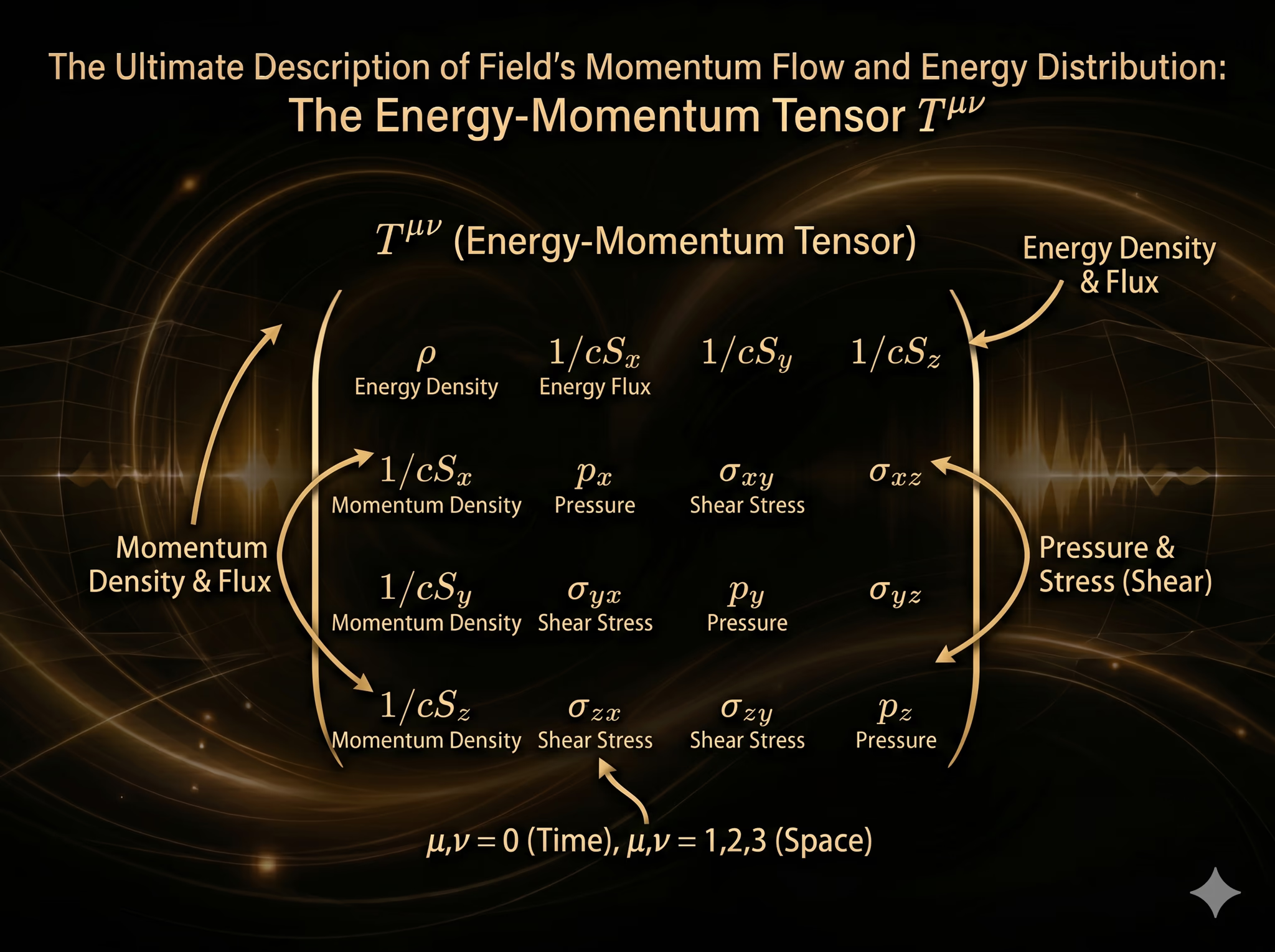
In gravitational physics, scalar density and three-vectors are not enough to describe the full state of matter and fields. A gas has not only total energy but pressure and shear stress in each direction; electromagnetic radiation has not only energy density but momentum flow and stress. The stress-energy tensor unifies these quantities in a matrix and serves as the source term in Einstein’s equations :
is energy density; in the non-relativistic limit it dominates the Newtonian gravitational potential—this is why the everyday statement that mass produces gravity corresponds first to energy density in relativity. and describe flows of energy and momentum, participating in effects such as frame dragging: a massive rotating body drags nearby spacetime, closely tied to energy-momentum flow. Diagonal spatial components correspond to pressure; in general relativity pressure also sources gravity, crucial for equilibrium and collapse of massive stars—a star is held up not only by mutual gravitational attraction but by radiation pressure and gas pressure. Off-diagonal components () describe shear stress, appearing in media with internal friction or anisotropy.
The equation expresses covariant conservation of energy-momentum, consistent with the equations of motion of matter in curved spacetime. Matter distribution tells spacetime how to curve through ; curvature tells matter how to move through geodesic deviation—this is general relativity’s overall account of interaction, gathering the “field” and “conservation” threads of the previous sections into geometric language.
5. Summary
Force in classical mechanics remains useful macroscopic language for measurement and engineering design; field theory reduces it to momentum exchange and field propagation while satisfying causality; general relativity couples matter, fields, and geometry through . The three describe the same physics at different levels, not three unrelated stories. From action-at-a-distance “force” to local “field” to geometric coupling in curved spacetime, each step answers a concrete problem left by the previous level.