Table of Contents
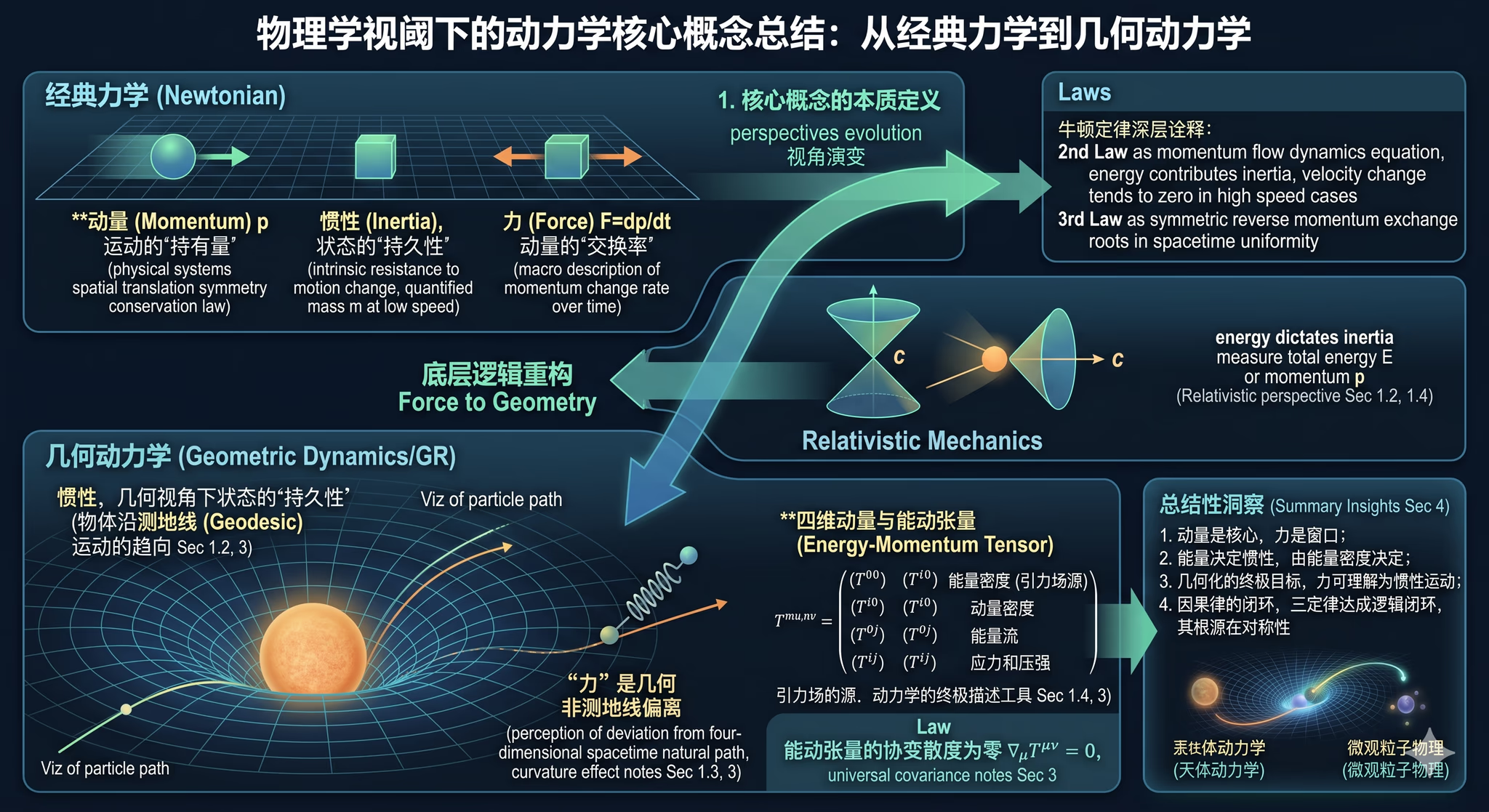
Dynamics studies how the state of motion of bodies changes under interactions. School courses center on “force”—push or pull, and acceleration changes accordingly. University physics and relativity more often start from momentum, energy, and symmetry, with force as a derived quantity. Four quantities—momentum, inertia, force, and energy-momentum—link across theories; clarifying their relations helps explain why Newton’s second law as is more fundamental than , and which concepts are kept and which are generalized when moving from Newtonian mechanics to relativity.
1. Momentum
In the non-relativistic case, momentum describes the magnitude and direction of the state of motion. It is first a dynamical variable: for equal mass, larger momentum means more impulse is needed to stop or deflect the body. Noether’s theorem shows that momentum is the conserved quantity corresponding to space-translation symmetry—if physical laws have the same form everywhere in space, total momentum of an isolated system is conserved. This link means momentum conservation is not an empirically added rule, but a consequence of spatial homogeneity.
Interaction can be understood as momentum exchange. In a collision between two bodies, an increase in one body’s momentum is often matched by a decrease in the other’s; macroscopically we still say “a force acts,” but the microscopic picture is transfer of momentum. Thus can be read as “force equals rate of change of momentum” or as “force describes the intensity of momentum exchange per unit time.” School courses often introduce force before momentum because force is easier to measure in macroscopic experiments; in theoretical structure, momentum and conservation laws sit earlier.
2. Inertia
Inertia is the property of resisting change in the state of motion. Classical mechanics quantifies it with rest mass : the larger the mass, the smaller the velocity change produced by the same impulse. Inertia is therefore closely tied to momentum—slow change of momentum appears as “hard to push, hard to stop.”
In relativity, rest mass alone is no longer the only measure. Total energy () and momentum together determine the impulse needed to change the state of motion. The higher the particle speed, the larger , and the smaller the acceleration produced by the same force—this is the mathematical reason massive bodies cannot reach : not because “some wall blocks them,” but because inertia grows with speed and continued acceleration requires ever more impulse. Photons have zero rest mass but nonzero momentum ; changing a photon’s direction requires impulse, as when the Sun’s gravitational field deflects light—the effect is still a change in momentum direction, with gravity altering the photon path through curved spacetime.
In general relativity, a freely falling body moves along a geodesic, which can be viewed as “inertial motion” generalized to curved spacetime: with no external force, the body moves as straight as spacetime geometry allows. Support forces in an elevator, electromagnetic forces, and the like deflect the worldline from a geodesic, and we perceive those deflections as “force.” Inertia is thus further generalized from “how large the mass is” to the geometric property of “moving freely along geodesics.”
3. Force
Force is not a basic entity independent of momentum, but the rate of change of momentum: . Classical textbooks often start from force because it is easy to measure macroscopically; field theory and relativity more often start from conservation laws and field equations, with force as a derived quantity. This ordering difference can suggest that relativity “abolishes force”; in fact relativity keeps the operational definition of force while embedding it in four-momentum and geometric structure.
In general relativity, “forces” other than gravity (electromagnetic force, friction, support force, etc.) correspond to worldline deviation from geodesics. Gravity itself can be eliminated locally by coordinate transform under the equivalence principle, appearing as curved spacetime rather than as a four-vector force—you standing on the ground feel “weight,” which in a freely falling frame becomes a locally acceleration-free picture, yet globally curved geometry is still required. Electromagnetic and similar forces cannot be globally removed by coordinate transform and still appear as sources of geodesic deviation.
4. Energy-momentum
Relativity merges energy and momentum into four-momentum , covariant under transforms between inertial frames. High-energy physics almost always uses this form because particle collisions, decays, and radiation processes must conserve energy-momentum in every reference frame.
To describe the distribution of matter and fields, the four-momentum of a single particle is not enough; the stress-energy tensor is needed: is energy density, and describe energy flow and momentum density, and describe stress. It is the source term in Einstein’s equations , coupling matter, fields, and spacetime geometry. From Newton’s “mass produces gravity” to Einstein’s “stress-energy distribution determines curvature,” the missing link is writing energy, momentum, and pressure together in .
5. Where Newton’s laws sit in the whole picture
The second law identifies interaction strength with rate of change of momentum, summarizing the threads of the first three sections. The third law states that action and reaction are equal and opposite—that is, momentum exchange between two bodies occurs in pairs: you push a wall, the wall pushes you, and total momentum of the system is unchanged. For an isolated system with no external force, , i.e. total momentum is conserved; this follows from spatial homogeneity (translation symmetry), not from the third law alone as an extra assumption.
The table below summarizes correspondences among several concepts in classical mechanics, special relativity, and general relativity. Starting from momentum conservation and symmetry, the “rate of change” form of the second law and the “paired exchange” form of the third law can be seen as two faces of one structure; in relativity this structure extends to four-momentum conservation and, in general relativity, couples to and the geometric equations.
| Item | Newtonian mechanics | Special relativity | General relativity |
|---|---|---|---|
| Measure of inertia | Rest mass | Energy , momentum | Motion along geodesics |
| Role of force | Rate of change of four-momentum | Deviation from geodesic | |
| Conservation | Separate momentum and energy | Four-momentum conservation | |
| Spacetime structure | Absolute, flat | Minkowski spacetime | Curved spacetime, dynamical |