Table of Contents
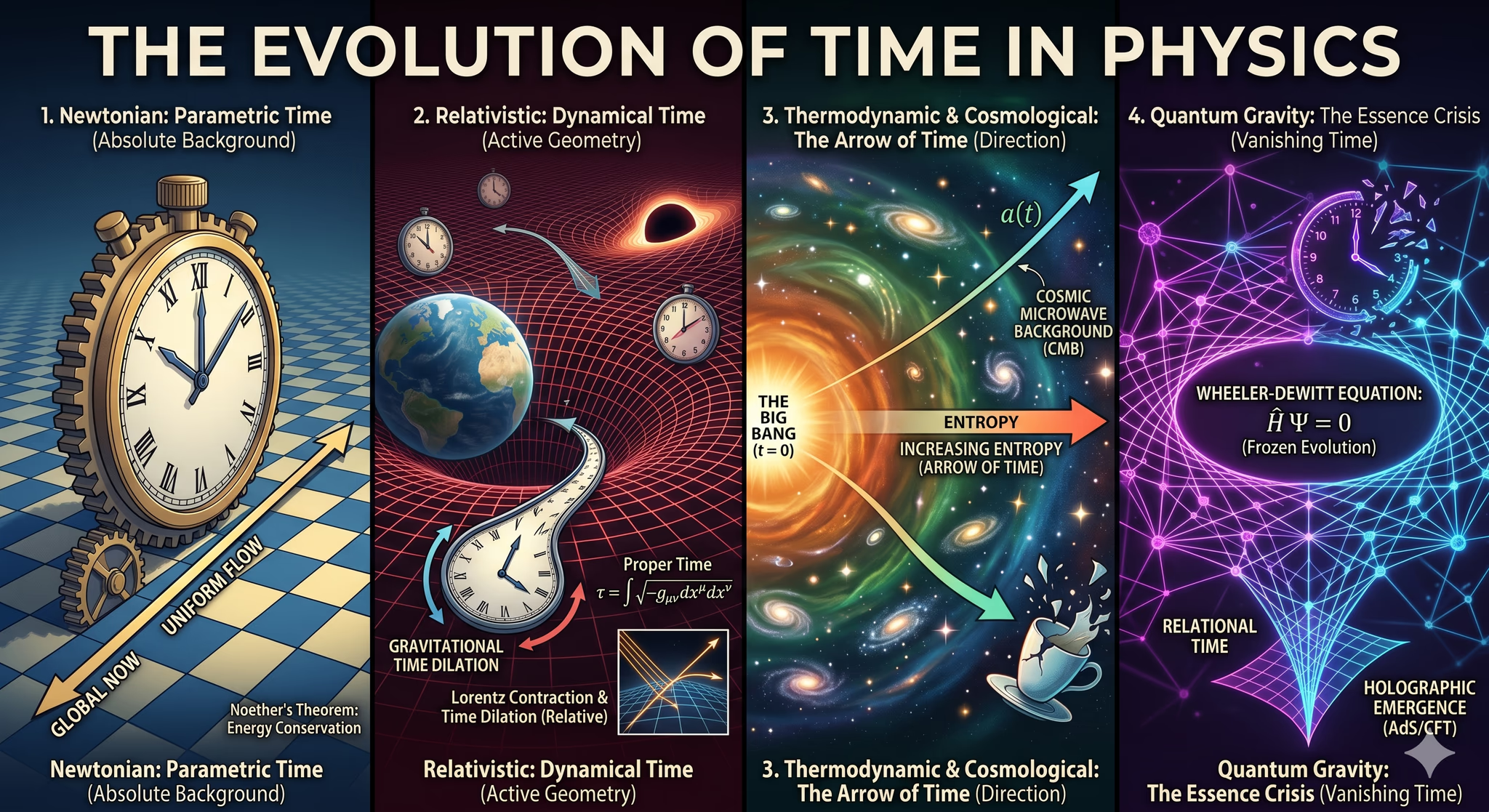
In everyday language, “time” often means clock readings or the order of events. Physics asks a different question: what role does time play in the fundamental equations, and does it change with the distribution of matter? Different theories give different answers, and each usually keeps part of the previous picture while revising it under new experimental or mathematical constraints. The four stages below trace this development; as you read, notice the problem each section opens with, and how the gap left by the previous stage is filled by the next.
1. Classical mechanics: parametric time
Newton defined time as a global quantity, uniform and independent of any particular body. All observers share one clock; under Galilean transforms between inertial frames, the time component is unchanged (). Space and time form a fixed background: bodies move on the stage but do not reshape the stage itself. This “background spacetime” picture matches everyday experience—whether a train moves or not, the clock on the platform seems to keep the same time.
In Newton’s second law , is therefore an external parameter: it marks how far evolution has proceeded, without participating in the dynamics or changing because matter is present. Noether’s theorem further links this structure to conservation: if physical laws do not change under time translation, energy is conserved; time-translation symmetry and energy conservation correspond one to one. Classical mechanics thus pins “time” outside the equations, as the scale on which all change is measured.
By the late nineteenth century, however, electromagnetism already suggested that this picture might be incomplete. Maxwell’s equations give a vacuum speed of light independent of the motion of the source; if all inertial frames are to obey the same laws, Galilean transforms would make the measured speed of light depend on the observer’s motion, in conflict with experiment. Absolute time began to loosen precisely from contradictions of this kind.
2. Relativity: geometric time
Special relativity abandons absolute simultaneity and merges time with space into four-dimensional Minkowski spacetime. The line element
is invariant under Lorentz transforms between inertial frames—time is no longer the component that sits still in every transform, but participates on equal footing with spatial coordinates.
Two kinds of time must be distinguished here, or “time dilation” is easily mistaken for a fault of the instrument. Coordinate time depends on the choice of reference frame; different inertial frames are related by Lorentz transforms, and time dilation is the relativity of coordinate time. Proper time , obtained by integrating along an observer’s worldline, is an invariant; two people may age by different amounts of proper time before meeting, yet the meeting event itself is consistent in causal structure. Causality is limited by light cones, not by a single universe-wide “now”—this is how “before and after” are redefined once absolute time is given up.
General relativity goes further: spacetime is no longer only a stage but a dynamical object. The metric describes geometry and evolves with matter. Einstein’s equations couple curvature to stress-energy—matter tells spacetime how to curve, and curvature tells matter how to fall. The deeper the gravitational potential well, the slower proper time flows; atomic clocks on GPS satellites run slightly faster than on the ground because the gravitational potential at orbital altitude differs, and this effect must be combined with the special-relativistic velocity correction for meter-level navigation accuracy.
In a generic curved spacetime there is usually no global time coordinate covering all of spacetime; such a coordinate is convenient only when the spacetime has suitable symmetry, such as staticity or homogeneity and isotropy. Relativity thus promotes “time” from an external parameter to part of geometry, even a quantity that matter can “slow” or “bend”—but where the macroscopic arrow of time comes from, relativity alone does not fully answer.
3. Thermodynamics and cosmology: macroscopic time direction
Relativity successfully geometrized time, yet it sharpens a contrast with everyday intuition: microscopic fundamental equations (Newton’s laws, Maxwell’s equations, Schrödinger’s equation) are approximately symmetric under ; the equations alone do not distinguish past from future. Yet we remember the past, cannot precisely predict the future, and shattered cups do not spontaneously reassemble—the macroscopic world has a definite direction. The question shifts: if microscopic laws are time-symmetric, where does the macroscopic arrow come from?
Thermodynamics gives the first clue. Entropy of an isolated system tends to increase in a statistical sense, defining the thermodynamic arrow of time. Entropy increase does not mean microscopic processes are absolutely irreversible, but that macroscopic states evolve toward more probable microscopic configurations; the direction we perceive is closely tied to the universe beginning in a low-entropy initial state. If the initial entropy were already near maximum, macroscopic evolution would be hard to orient in time, and the arrow would blur. Geometric time tells us how to order events; thermodynamic time tells us why that ordering appears one-way at macroscopic scales.
Cosmology provides another macroscopic scale. In the homogeneous, isotropic FLRW model, comoving observers can share a cosmic time that evolves with the scale factor , consistent with observations such as the cosmic microwave background and galaxy recession. This scale describes the expansion of the universe as a whole, not a special preference of some local clock; it unifies concepts such as “age of the universe” and “redshift” under one time coordinate. By this point, time in physics carries at least three related but non-identical roles: parameter or geometric component in equations, local flow in the sense of proper time, and direction and scale in the macroscopic and cosmological sense.
4. Quantum mechanics and quantum gravity
In the quantum domain, the status of time changes again, and in tension with general relativity. In standard quantum mechanics, Schrödinger’s equation still treats as an external parameter, close to the classical “parametric time” picture; Pauli’s theorem shows that time cannot correspond to a general self-adjoint operator like position, so we cannot define a universal “time operator” in the same way we measure position. Quantum evolution thus keeps an external clock in practice, without fully resolving conceptually who is timing the universe.
When general relativity is quantized and subjected to a decomposition, the Hamiltonian constraint yields the Wheeler–DeWitt equation for the wave function of the universe, formally without external time evolution—the “problem of time.” If the fundamental equations contain no time parameter, where does macroscopic temporal flow come from? Different approaches treat this differently: some introduce relational time, replacing an absolute clock with relative change among intrinsic variables such as the scale factor; others treat macroscopic time as an effective quantity derived from more basic degrees of freedom, as in holographic dualities. No complete quantum-gravity theory is yet accepted, and the place of time in the deepest equations remains open.
5. Summary
The four stages do not simply replace one another; they mark levels at which time is defined. Global parameter time in Newtonian mechanics becomes part of spacetime coordinates in special relativity; in general relativity it becomes a dynamical geometric quantity that can curve and couple to matter; thermodynamics and cosmology explain the macroscopic arrow and cosmological scale; quantum gravity asks whether this hierarchy still holds at the microscopic limit. The table below summarizes the main role of time at each stage for side-by-side comparison.
| Stage | Role of time |
|---|---|
| Newtonian mechanics | Global external parameter, decoupled from space |
| Special relativity | Coordinate component unified with space; proper time invariant |
| General relativity | Dynamical geometric quantity described by the metric |
| Thermodynamics / cosmology | Macroscopic direction of evolution, tied to initial state and entropy |
| Quantum gravity | Status in fundamental equations unsettled; multiple schemes |