From Force to Field, From Symmetry to Flux: Reconstructing the Ultimate Landscape of Fundamental Interactions
In the realm of classical mechanics, we are conditioned to speak in terms of “force.” Force is reciprocal; force alters states of motion. However, in the eyes of modern physics—specifically within General Relativity and Quantum Field Theory—the concept of “force” gradually recedes into the background. It is replaced by a more fundamental and universal logic: Locality and the exchange (flux) of Energy-Momentum.
I. Field Ontology: From “Mathematical Intermediary” to “Physical Entity”
In introductory physics, the electric field is often described merely as a “medium” for interactions between charges. While practical, this description obscures the ontological status of the field itself. The profound insight of field theory is the confirmation that the field is matter. It is not a void of mathematical abstraction but a physical reality possessing independent degrees of freedom.
- Independence: Even if the source charge is removed, electromagnetic waves continue to propagate through the vacuum at the speed of light, carrying energy and momentum across galaxies.
- Physical Interpretation: What we traditionally call “force” is, in essence, the rate of momentum exchange between the field and the particle.
This relationship of momentum exchange can be expressed as:
Where:
- : The vector force acting on the particle (represented in bold Roman type to denote its vector nature).
- : The mechanical momentum of the particle.
- : The momentum stored within the field. When a particle experiences a force, it is fundamentally exchanging momentum with the field.
II. Locality: The Physical Bottom Line of Causality
Locality is the watershed that separates classical mechanics from modern physics. Newton’s universal gravitation relied on “action-at-a-distance,” assuming that influences could traverse space instantaneously. This, however, violates the relativistic principle of causality—the tenet that information cannot exceed the speed of light.
The Requirement of Locality: Any physical event can only couple with points in its immediate spacetime neighborhood. Without the “field” as a continuous carrier, the causal transmission restricted by the speed of light would be impossible. The field is the bedrock that ensures the logical self-consistency of the universe.
III. Projections of Symmetry: A Unified View of Energy-Momentum
Why is physics so preoccupied with energy and momentum? Noether’s Theorem provides the ultimate answer: every continuous symmetry corresponds to a conservation law.
- Time Translation Symmetry Conservation of Energy (The laws of physics remain consistent across yesterday, today, and tomorrow).
- Space Translation Symmetry Conservation of Momentum (The laws of physics remain consistent here, there, and everywhere).
Within the four-dimensional spacetime framework, energy and momentum are no longer two disparate quantities but projections of a single Four-momentum Vector ():
- : The four-momentum, where denotes the spacetime components.
- : The temporal component, corresponding to energy.
- : The spatial components, corresponding to traditional three-dimensional momentum.
- The Ontological Insight: Energy is momentum in the temporal direction; momentum is energy in the spatial direction.
IV. The Energy-Momentum Tensor: The Dynamic Ledger of the Universe
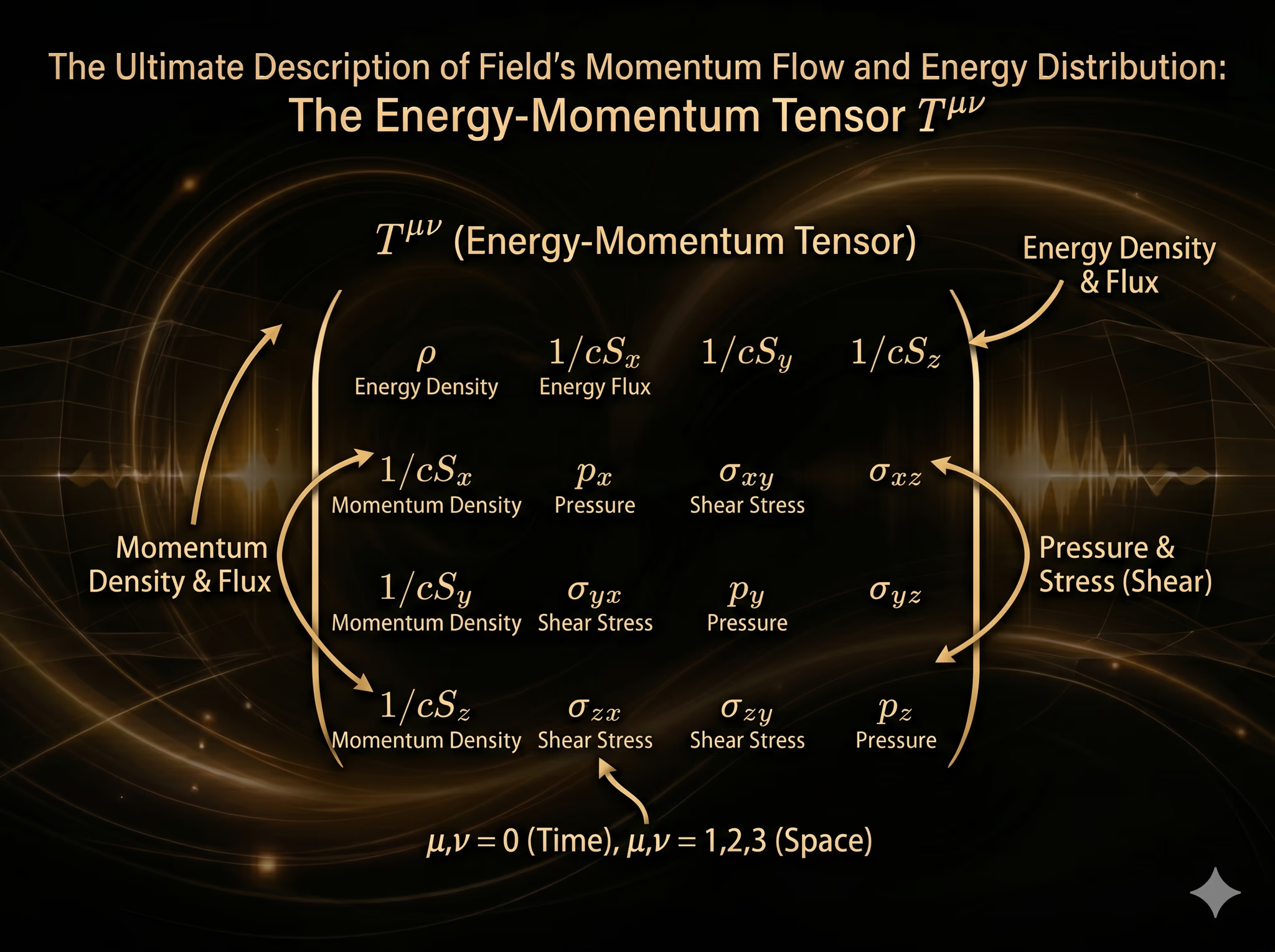
For those of us researching gravity, nothing is more captivating than the Energy-Momentum Tensor (). It is the definitive second-order tensor describing the distribution and flow of matter, energy, and stress.
In the Einstein Field Equations (), this tensor serves as the ultimate source of gravity. It reveals that all physical interactions are, at their core, the transfer, transformation, and redistribution of energy-momentum within the spacetime coordinate system.
Its explicit matrix form is as follows:
Functional Breakdown of the Components:
-
(Energy Density):
- Meaning: The total energy per unit volume, including rest-mass energy () and all forms of internal energy.
- Action: In the non-relativistic limit, this is the dominant source of the Newtonian gravitational potential. It is the primary “weight” that curves spacetime.
-
(Energy Flux) & (Momentum Density):
- Meaning: These symmetric terms represent the flow of energy across spatial boundaries and the momentum stored within the field.
- Action: They describe how energy-momentum “moves.” In General Relativity, these terms are responsible for frame-dragging (the Lense-Thirring effect), where a rotating mass actually “drags” the fabric of spacetime around with it.
-
(Normal Stress / Pressure ):
- Meaning: The force per unit area acting perpendicular to a surface, resisting compression.
- Action: Unlike Newtonian gravity, where only mass counts, General Relativity dictates that pressure also gravitates. High pressure increases the gravitational pull, a critical factor in the internal equilibrium (and eventual collapse) of massive stars.
-
(Shear Stress):
- Meaning: The tangential force per unit area that tends to slide layers of a medium past each other, causing deforming “shear.”
- Action: It describes the internal friction and viscosity of a system. Physically, it represents the lateral transfer of momentum. In the cosmic fluid, shear stress is a vital component in describing gravitational waves and the anisotropic expansion of the early universe.
In essence, ensures that the “ledger” of the universe always balances. Matter and spacetime achieve their ultimate logical unification here: energy-momentum flux is not just “contained” in spacetime; it is the very architect of its geometry.
V. Conclusion: The Simple Elegance of Flux
When we strip away the intricate formalisms, the picture of the universe becomes remarkably pure: The universe is a spacetime continuum woven from various “fields,” and so-called “particles” are merely local ripples or excitations within these fields.
All macroscopic physical phenomena—be they mechanical, thermal, optical, or electrical—are ultimately the conserved flux of energy-momentum within this continuum. We no longer search for the origin of “force”; instead, we observe how energy-momentum elegantly leaps from one form to another, gliding from one region of spacetime to the next.
This is perhaps the most profound romance physics offers: that in this ever-changing world, there exist underlying logics of symmetry and flux that sustain the architecture of all things.
About the Author: Chen Hua is an independent researcher and PhD in Physics, specializing in gravity, cosmology, and physics education.